

What throughput do you need to sustain?
Start with the tonnes per hour you must average across a shift, not the peak. The series is rated up to 30 t/h, and drive power climbs from twin 75 kW drives to a single 280 kW drive as you move up the range.
The SRD series is a heavy duty single shaft shredder used as a secondary reduction stage: material arrives already broken down, and the machine's job is a uniform particle size between 40 and 100 mm. Chamber width from 1,593 up to 3,006 mm, Ø530 or Ø650 rotors and throughput up to 30 t/h are what decide which industrial single shaft shredder model a shift can actually sustain.
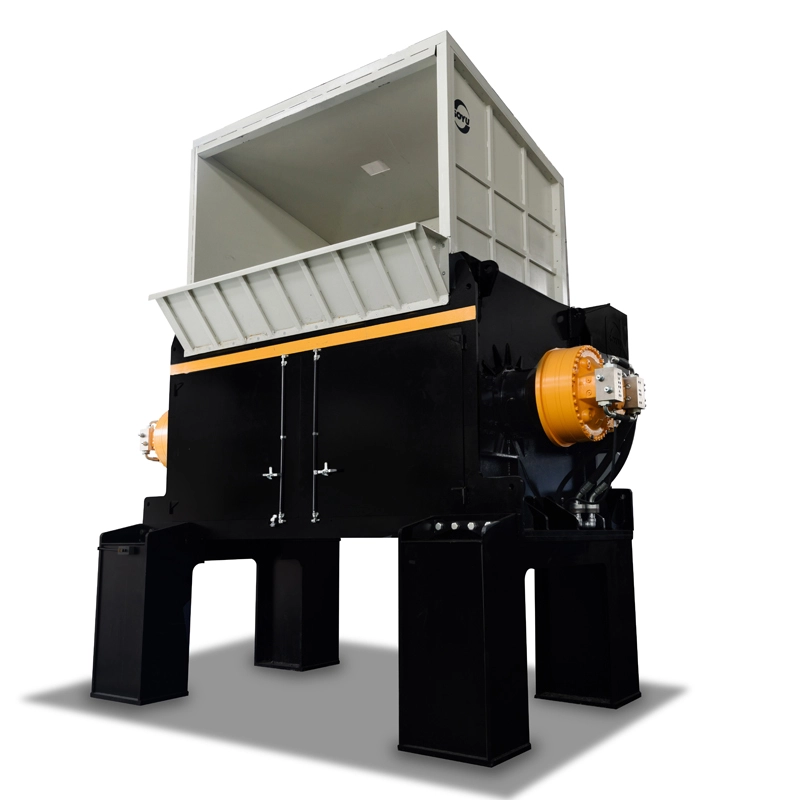

The SRD is a secondary shredder: material arrives already broken down, and the machine's job is uniformity. A hydraulic ram pushes the load into a modular rotor fitted with oversized wear-resistant blades on a fabricated cutter holder, and a screen under the rotor sets the particle size that leaves the chamber. Cutting chambers run from 1,600 mm to 3,000 mm, blades are surface-hardened, and a high-sensitivity torque limiter plus a hydraulic maintenance flap gate protect the machine when something unshreddable gets through.
Built for waste recyclers, manufacturing plants, material recovery operations and industrial waste-reduction facilities handling wood and pallets, plastic and plastic lumps, film and woven bags, paper and cardboard, aluminium and UBC, RDF and MSW, glass fibre and FRP, e-waste, and leather or textile scrap.
Skip to the four-question model selectorAnswer four questions about the job in front of you. Each answer narrows the field, and the four together point to one of the published SRD models — SRD1600, SRD2100, SRD2500 or SRD3000.
Start with the tonnes per hour you must average across a shift, not the peak. The series is rated up to 30 t/h, and drive power climbs from twin 75 kW drives to a single 280 kW drive as you move up the range.
Loose film and woven bag at low bulk density needs volume, not force. Dense lumps and pallets need torque and blade count. Chamber width decides how much volume sits over the rotor at once; ram travel decides how hard the material is pushed in.
Output is set by interchangeable screens and fine-tuned with a frequency converter. The published table fits 40 mm screens to SRD1600, SRD2100 and SRD2500, and an 80 mm screen to SRD3000 — the range covered overall is 40 to 100 mm.
Contamination decides how much protection and access you want. Every SRD model carries a high-sensitivity torque limiter, a hydraulic maintenance flap gate for pulling out non-shreddable objects, and a hydraulically opening screen unit for clearing the chamber.
| Typical answer set | Start with | Why that model |
|---|---|---|
| Moderate tonnage, mixed plastics and wood, 40 mm output, restricted floor space | SRD1600 | Smallest chamber at 1,593 × 1,626 mm and roughly 11,000 kg, with twin 75 kW drives and 54 rotor blades. |
| Pallet and lump duty that needs more blade passes per revolution | SRD2100 | 2,055 mm chamber, 69 rotor blades, twin 90 kW drives and the same 470 mm ram travel and 40 mm screen as the rest of the Φ530 group. |
| High-volume film, woven bag and cardboard where volume, not weight, is the constraint | SRD2500 | Widest chamber of the Φ530 group at 2,517 mm, 72 rotor blades and twin 110 kW drives, still at 792 mm discharge height. |
| Bulky, heavier feed, a coarse 80 mm product and high-level discharge | SRD3000 | 3,006 mm chamber, Φ650 rotor with 52 blades, a single 280 kW drive, 1,155 mm discharge height and roughly 25,000 kg. |
Not sure which column your plant sits in? Send your material and target output to an engineer and ask for a configuration review before you commit to a model.
Every figure below is published data for the four models. Read the table once for the numbers, then read the interpretation cards underneath for what each row costs you in layout, maintenance and output.
| Parameter | SRD1600 | SRD2100 | SRD2500 | SRD3000 |
|---|---|---|---|---|
| Main shaft speed (rpm) | 73–347 | 73–347 | 73–347 | 73–300 |
| Ram travel (mm) | 470 | 470 | 470 | 270 |
| Rotor diameter (mm) | Φ530 | Φ530 | Φ530 | Φ650 |
| Number of rotor blades (pcs) | 54 | 69 | 72 | 52 |
| Number of fixed blades (pcs) | 17+2 | 20+2 | 23+2 | 25+2 |
| Screen holes diameter (mm) | 40 | 40 | 40 | 80 |
| Motor power (kW) | 2 × 75 | 2 × 90 | 2 × 110 | 280 |
| Hydraulic power (kW) | 7.5 | 11 | 11 | 11 |
| Cutting chamber dimensions (mm) | 1593 × 1626 | 2055 × 1626 | 2517 × 1626 | 3006 × 1620 |
| Discharge height (mm) | 792 | 792 | 792 | 1155 |
| Overall dimensions L × W × H (mm) | 2190 × 4100 × 2442 | 2190 × 4900 × 2442 | 2190 × 5400 × 2442 | 6620 × 2770 × 3955 |
| Weight (kg) | Approx. 11,000 | Approx. 13,500 | Approx. 16,000 | Approx. 25,000 |
The series is described as covering 150–280 kW of motor power. The published table reaches those totals through twin 75, 90 and 110 kW drives on SRD1600 to SRD2500 and a single 280 kW drive on SRD3000 — worth confirming for your exact electrical supply at quotation stage.
Width is residence time. A wider chamber holds more material over the rotor per ram stroke, which is what light film and woven bag need; it also pushes the machine footprint from 4.1 m to 5.4 m of length in the Φ530 group.
More blades per revolution means more cuts per pass and a tighter, more uniform product. SRD3000 trades blade count for a larger rotor diameter and a single 280 kW drive, which suits heavier, bulkier feed rather than springy film.
The screen is the product specification. Fitting a 40 mm screen on SRD1600 to SRD2500 keeps output fine; SRD3000 is published with an 80 mm screen for coarser reduction. Screens are interchangeable, so contract changes can be met with a screen change.
Ram travel tells you how far the feed pusher strokes into the chamber. The longer 470 mm stroke on the three smaller models suits loose, low-density loads that must be compacted; SRD3000's 270 mm stroke works with material that already fills the chamber.
This row decides your downstream handling. At 792 mm, the three smaller models discharge to a low conveyor or bunker; at 1,155 mm, SRD3000 clears taller receiving equipment without an extra incline.
Weight drives foundation, lifting plan and transport. SRD3000 is more than double the mass of SRD1600 and its overall dimensions step to 6,620 × 2,770 × 3,955 mm, so confirm slab loading, crane capacity and access routes before ordering.

Model selection sets the envelope; the options below decide how the machine behaves day to day. Each one answers a specific operating problem, so specify them against your own maintenance history rather than as a default package.
SRD1600, SRD2100 and SRD2500 run twin motors; SRD3000 runs one 280 kW motor. Choose the twin arrangement where a single motor failure should not stop the line outright, and check the starting current your supply can take either way.
The ram is inside the frame, which keeps the structure compact and delivers a stable, consistent feed. It matters most on light, springy material that would otherwise ride on top of the rotor instead of being cut.
Together these give adjustable output particle size without changing the machine. Specify a second screen size if you sell into two product contracts with different size limits.
Autonomous protection that trips before unshreddable material damages the rotor or drive. It is the difference between a stopped machine and a broken one.
Both exist to cut downtime: the screen unit opens hydraulically for chamber access, and the flap gate lets operators pull out non-shreddable foreign objects quickly. On contaminated feeds this is the option that pays for itself.
Blades mount on a modular cutter holder built for rapid replacement, so a blade change is a scheduled task rather than a strip-down. Ask for the blade-change routine and a wearing-parts list with your quotation.
Up to 30 t/h is the series figure. What your plant actually sees depends on the material in the hopper and the screen in the machine, and it is worth being honest about that before the equipment lands.
Light film and woven bag move volume quickly but weigh very little, so a machine can be full and still far from its rated tonnage.
Wet paper and cardboard pack in the chamber; heavy contamination triggers the torque limiter and stops the stroke.
The screen decides how long material stays above the rotor. A 40 mm screen holds material longer than an 80 mm screen, so output size and throughput move in opposite directions.
Blunt blades pull more power for less reduction. Schedule blade replacement off tonnage processed, not off the calendar.
A ram that strokes continuously is a machine running at capacity. If it is pausing, the feed or the pre-shred stage is the constraint, not the rotor.
Secondary shredding assumes material has already been opened up. Oversized pieces slow the ram and reduce every downstream figure.
8 t/h of loose film at roughly 120 kg/m³ is about 67 m³ of material every hour. That volume — not the tonnage — is what has to pass the chamber and the screen. Bring both numbers to the sizing conversation: the weight you must ship and the volume the machine must swallow.


A quotation is only as good as the brief behind it. Include the points below and an engineer can come back with a model, a screen recommendation and a drive configuration instead of a generic price.
Screen size, frequency converter settings and drive configuration are specified per project, so tell us where your requirements differ from the standard table and ask about project-specific build.
Keep adjacent product options together for a faster catalog comparison.
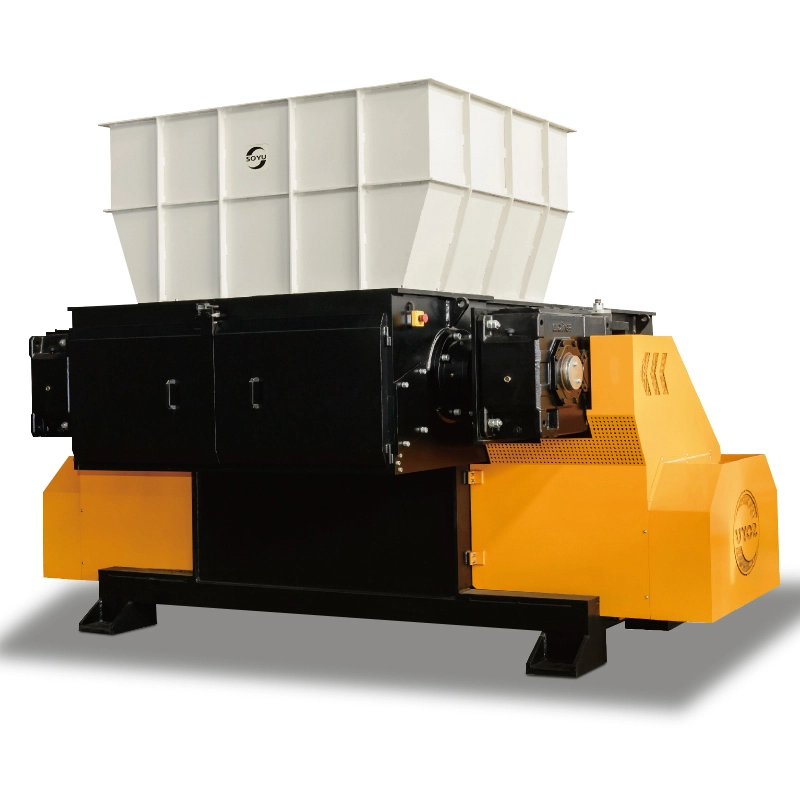
Looking for a reliable Single Shaft Shredder? SOYU SR series offers high-performance size reduction for plastic, wood, and metal waste. Factory-direct price, CE certified, and customizable screens…
View product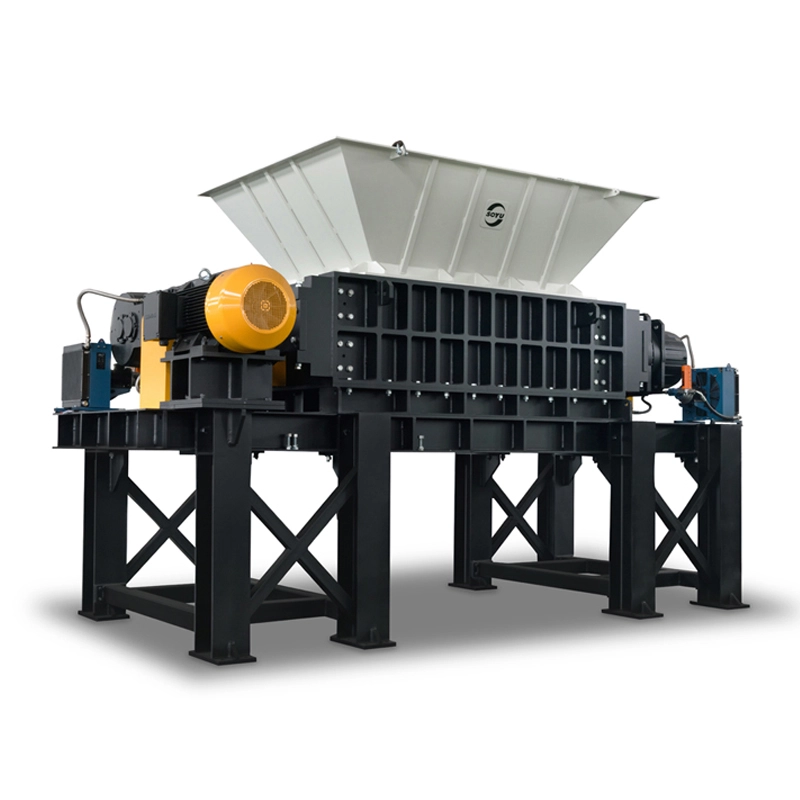
Explore SOYU industrial twin shaft shredders for metal scrap, tires, plastic drums, bulky waste and recycling applications. Compare machine specifications and request a customized solution.
View product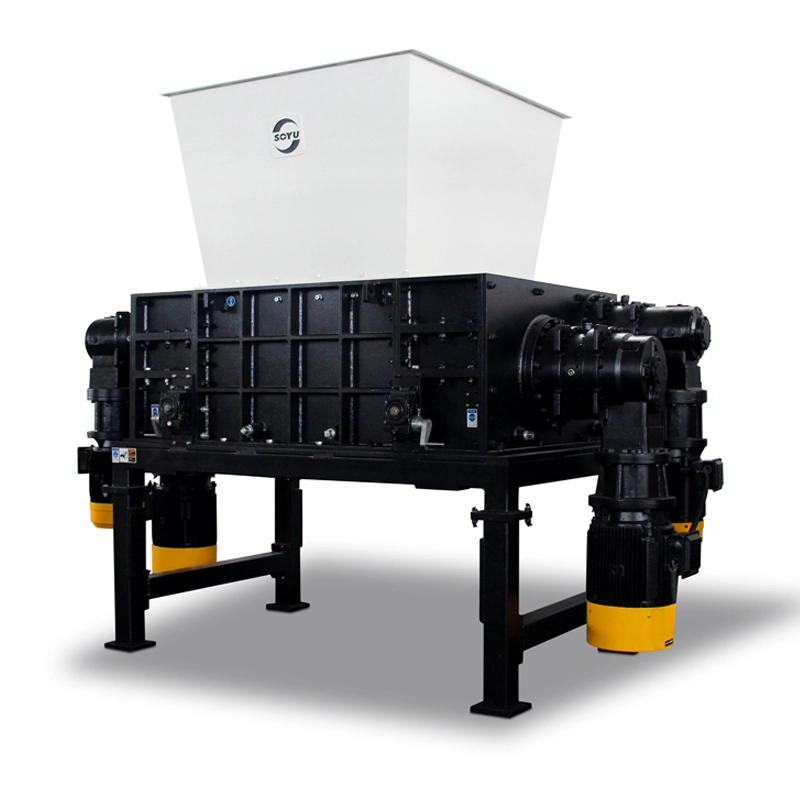
SOYU manufactures industrial four shaft shredders for waste size reduction and recycling. Explore FS Series configurations, screen-based output sizing and application options.
View productwood and wood pallets, plastic and plastic lumps, film and woven bags, paper and cardboard, aluminium and ubc, rdf and msw, glass fibre and frp, e-waste, and leather or textile scrap. it is designed as a secondary shredder delivering a uniform, consistent particle size rather than first-pass volume reduction.
use chamber width and feed character first. srd1600 to srd2500 share a φ530 rotor, 470 mm ram travel, 792 mm discharge height and 40 mm screens, with chambers of 1,593, 2,055 and 2,517 mm. srd3000 steps to a 3,006 mm chamber, a φ650 rotor, 52 rotor blades, 270 mm ram travel, an 80 mm screen, 1,155 mm discharge height and roughly 25,000 kg.
the range is 40 to 100 mm, determined by the screen mesh hole size and adjustable through interchangeable screens and a frequency converter. the published table fits 40 mm screens to srd1600, srd2100 and srd2500, and an 80 mm screen to srd3000.
a high-sensitivity torque limiter protects the rotor and drive from overload, and a hydraulic maintenance flap gate gives quick access for removing non-shreddable foreign objects. both are standard features across the series.
blades are oversized and wear-resistant, mounted on a modular, surface-hardened shaft system with a fabricated cutter holder built for rapid blade replacement. the hydraulic screen opening gives direct access to the cutting chamber for screen cleaning or replacement, which keeps planned downtime short.
the series is stated as compliant with iso 9001 and ce. to get a quotation, send your material type, bulk density, target particle size, required tonnes per hour, contamination level, electrical supply and space constraints through the contact page.

